A Calculus of Representation
Three Volumes by Set Lonnert • Books on Demand • 2026
This calculus of representation, in three volumes, develops a framework carried since the 1980s: a notation that keeps what there is and how it is grasped on the page at the same time, instead of collapsing either into the other.
The first volume sets the notation down, and finds it already present — unremarked, and six centuries apart — in Ockham and in Frege. The second sets it in motion, and asks what a record of an inquiry still holds once the inquiry has changed its mind. The third peoples that record: it asks what becomes of it when it is kept not by one inquirer but by many.
The indefinite article in the title is load-bearing: it names the project, so that Volume One can be the calculus, Volume Two its dynamics and Volume Three the peopled record without any title repeating the label standing above it. A reader who begins with a later volume should not be at a disadvantage.
The Volumes
Set down, set in motion, then shared
The Ontological–Cognitive Representation Calculus is a still picture, and deliberately so: it separates object from cognition, and assertion from both truth and content, and then shows that the same separation was already being made by Ockham and by Frege.
The Dynamics of Representation makes that picture move. If a notation can hold an object apart from the way it is given, what does it do when the way it is given changes — when a science revises, a court reverses, a commitment is taken back?
The Peopled Record lets others in. A record that one inquirer keeps is already a history of acts; a record that many keep is a history of who did what, on whose word, and who is left holding it when someone else withdraws.
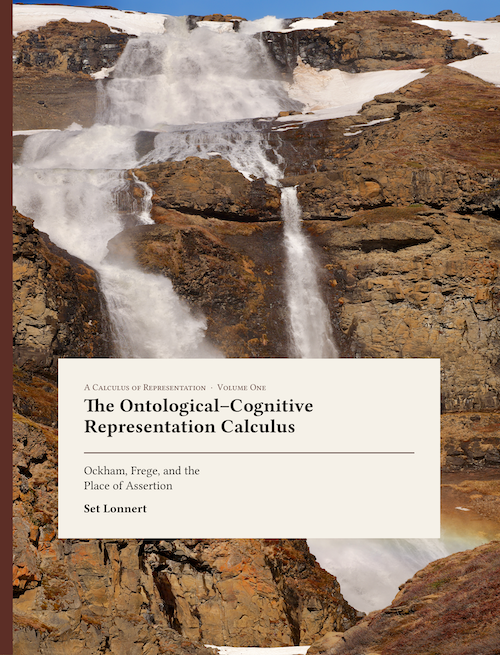
The Ontological–Cognitive Representation Calculus (2026)
Ockham, Frege, and the Place of Assertion. Volume One of A Calculus of Representation.
They are taught apart, to different ends, by different people: Ockham on a thing and the concept that covers it, Frege on an object and the way it is given to us. The claim made here is that they are one failure seen from two sides.
Think of representation as a relation running from what there is to how it is grasped. Such a relation can fail to be a one-to-one correspondence in exactly two directions, and each direction already has a name. Fail in the first and you have a universal. Fail in the second and you have a sense. What this book builds is a notation that keeps both on the page at once instead of collapsing them into one — and it gives assertion a place of its own, as a third thing that is neither truth nor content.
It derives nothing. There is no proof system here and no transformation rules. What it offers instead is the ability to state ordinary difficulties that are otherwise merely reportable: the man who takes the morning star and the evening star for two different bodies, the reader gripped by a novel, the science that turned out to be wrong. The usual apparatus leaves two options — convict somebody of inconsistency, or let the object take the damage. A notation that separates the two places lets one say what happened.
Second, revised edition
ISBN: 978-91-8150-079-0
Format: 170 × 220 mm
Pages: 148
First published 2026, ISBN 978-91-8134-549-0
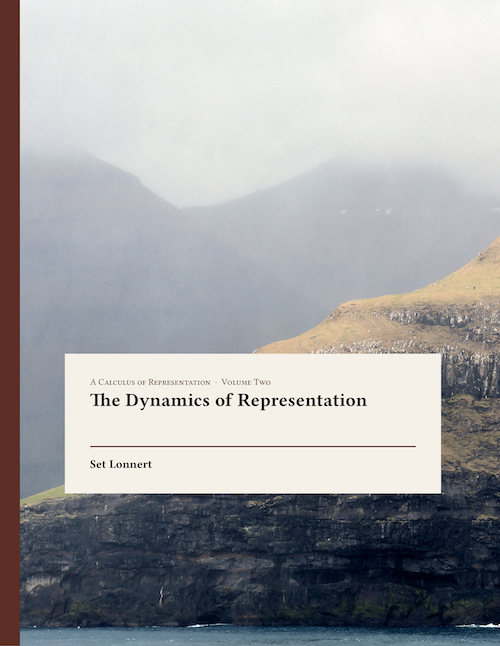
The Dynamics of Representation (2026)
Volume Two of A Calculus of Representation.
The first book gave two kinds of representational failure a place on one page. But a notation that holds an object apart from the way it is given is a still picture, and inquiry is not still. Sciences change their minds. This book asks what such a notation does when it is made to move.
What moves is a record. Not a set of beliefs closed under consequence, but a finite list of acts in the order they were actually performed: crossings made on a licence, undertakings, and registrations of what simply happened. A state is such a list, an act has an effect on it, and the question worth asking is what survives. Three operations take something back, and none of them will do another's work.
From there the book gives contents parts, puts a value to the coordinate the first volume deliberately left uncommitted, and adds a second agent who takes up what a first has undertaken. Then it runs the whole apparatus over four cases: the infinitesimal, light between 1900 and 1925, negation as failure, and precedent in conflict.
There is no axiomatisation here, no consequence relation and no completeness result — and none of the three is missing. A consequence relation is indifferent to how a premise was arrived at; that is its whole use, not a defect in it. This book exists to ask which way an inquiry was going, which is a question about how one came by something and about nothing else.
Edition: 1
ISBN: 978-91-8150-065-3
Format: 170 × 220 mm
Pages: 416

The Peopled Record (2026)
Volume Three of A Calculus of Representation.
The second book ended with a second agent taking up what a first had undertaken. That was a door left open. Inquiry is rarely done alone: a science is many hands, a court is many voices across many years, and the record they leave is not one person's list of acts but a shared one, written by people who did not always agree.
This book walks through the door. It asks what a record becomes when it is peopled — when an undertaking is made on someone else's word, when a licence is borrowed, when one party takes back what another is still relying on. The question the second volume put to a single inquiry, which way it was going, is put here to a community of them, and the answer is no longer only about how one came by something, but from whom.
Like its predecessors it derives nothing and is not trying to. It offers a notation in which the ordinary difficulties of inquiry done together can be stated rather than merely reported.
Edition: 1
Format: 170 × 220 mm